Good architecture starts with fewer moving parts.
A practical way to think about systems: start with the problem, keep the boundaries clear, and earn the complexity.

A diagram full of services can look impressive. The harder question is whether it helps the person who needs to maintain the system six months from now.
My starting point is simple: what must this product do, who will use it, and what happens when something goes wrong? Those answers are more useful than a list of fashionable tools.
Make the first version easy to understand
For a small product, one application and a well-structured database can be a sensible starting point. Keep business rules separate from the interface. Give modules clear responsibilities. Make configuration explicit.
A modular application leaves room to grow without making every change a distributed-systems problem. Separate services become useful when a particular workload, team, or reliability requirement actually needs that separation.
Design for the ordinary failure
An external API will eventually time out. A background job will fail. A deployment will contain a mistake. Planning for those cases is part of the design, rather than a task to leave until launch week.
- Put time limits on external calls.
- Retry only when repeating an operation is safe.
- Make jobs observable, with enough context to investigate a failure.
- Keep backups, and test a restore before you depend on one.
For a payment or order operation, blindly repeating a request can create a second transaction. Idempotency matters more than a clever retry loop.
Measure before splitting
If a page is slow, find the slow part. A missing database index, oversized image, or unnecessary network request may explain the problem. Moving the same bottleneck into another service will not remove it.
I want this approach to guide the technology work around Bitiac Group: understandable systems, useful measurements, and decisions that match the stage of the business. EternalPace is an upcoming sister concern, so these are engineering principles—not claims about an already operating platform.
The goal is a product that works well today and can change tomorrow. Sometimes the most thoughtful architecture is the one with the fewest boxes in the diagram.
Keep exploring
Another thought or two.
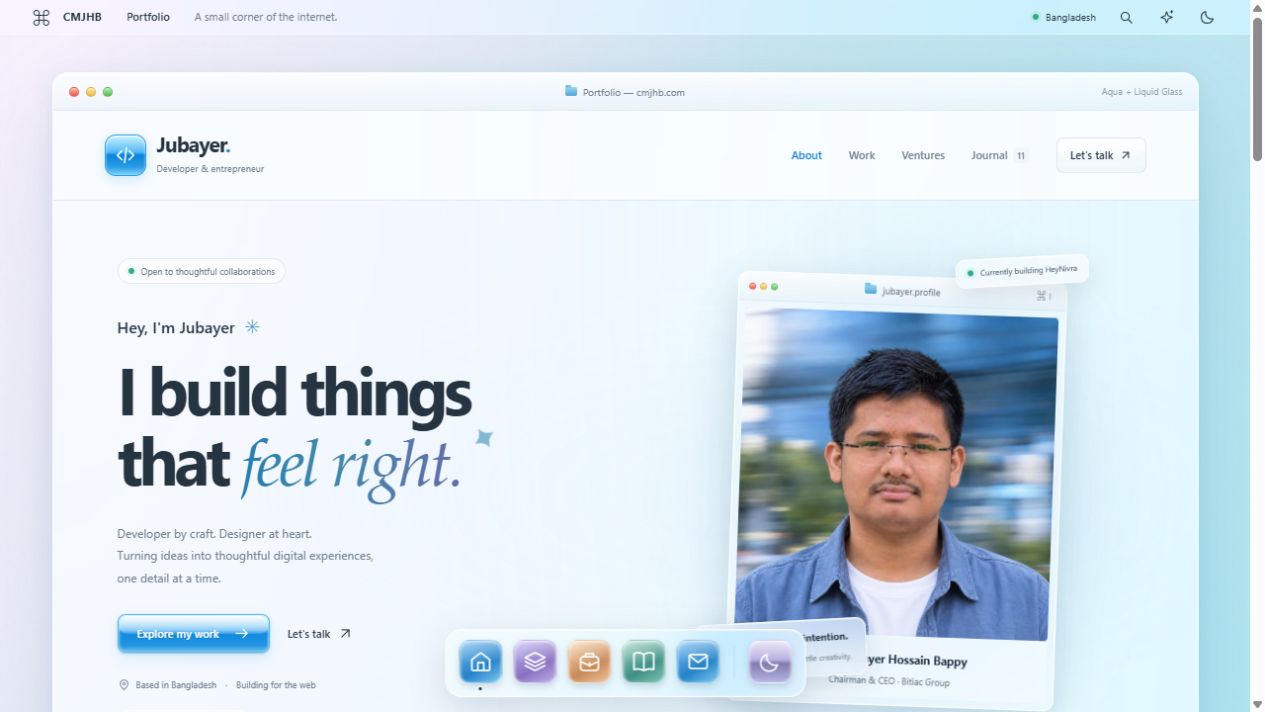
Less noise. More glass.
A little Aqua nostalgia. A little light through glass. I rebuilt my corner of the internet to feel softer, simpler, and more like me.
Before you add another WooCommerce plugin, measure.
Slow shops rarely need another mystery fix. They need a clear diagnosis, careful changes, and a checkout that still works.
What 100+ client projects taught me about clarity.
Good work needs more than good code. Scope, communication, and a useful handover deserve just as much care.