Sentinel-VC is out in the open.
An open-source project, a research preprint, and a small step toward more thoughtful Telegram moderation.


There is a different feeling to putting a project out in public. The code stops being something only you can inspect. Other people can ask better questions, find the rough edges, and take it somewhere you did not expect.
That is where Sentinel-VC is now.
A little context
Sentinel-VC is my open-source Node.js framework for Telegram moderation. It brings together event monitoring, rate limits, decaying evidence, and temporary restrictions, with a private panel for administrators.
The part I care about most is recovery. A moderation tool should have a clear way to give permissions back. A restriction should not quietly become permanent because nobody remembered why it happened.
Acting is only half the job. Knowing how to recover matters too.
There is also an optional administrator MTProto adapter for supported voice-call events and controls. Its capabilities depend on the session, permissions, and the events Telegram actually delivers. Those boundaries are part of the design.
The paper
On October 5, I published the first version of the accompanying research preprint: Sentinel-VC: Capability-Aware Event-Driven Moderation for Telegram Communities and Voice-Call State.
It explains the design and synthetic evaluation. It is a preprint, not a peer-reviewed result. Synthetic tests are useful for studying behaviour, but they do not establish real-world attack detection or crash prevention. I want that distinction to stay visible.
What comes next
The project is experimental. There is more to validate, especially around real deployment conditions and the limits of the available Telegram interfaces.
For now, I am glad the work is somewhere people can read it, question it, and contribute. That feels like a good beginning.
Explore the code on GitHub · Read the preprint on Zenodo
Keep exploring
Another thought or two.
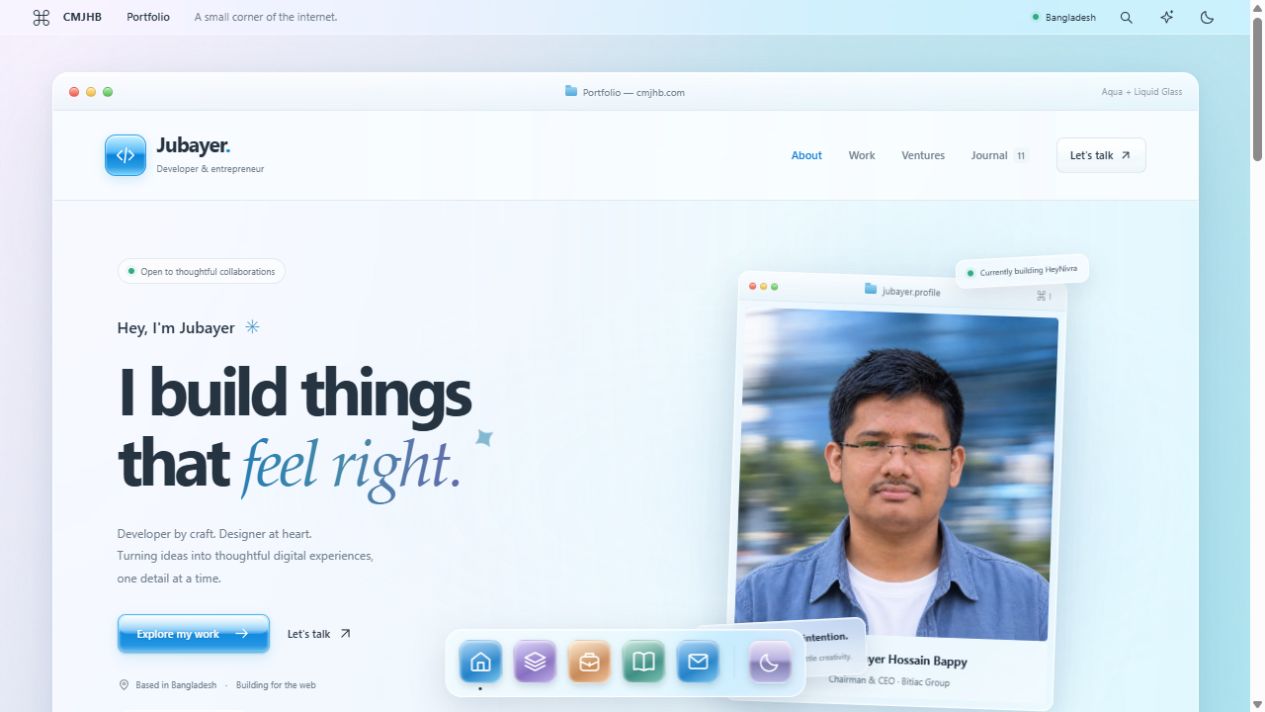
Less noise. More glass.
A little Aqua nostalgia. A little light through glass. I rebuilt my corner of the internet to feel softer, simpler, and more like me.
Good architecture starts with fewer moving parts.
A practical way to think about systems: start with the problem, keep the boundaries clear, and earn the complexity.
Good moderation leaves a way back.
A small design principle behind Sentinel-VC: think about recovery before adding another restriction.